
This article constitutes a synthesis of information drawn from: Richard Schwartz's book, Internal Family Systems Therapy (Schwartz, 1996), the Level 1 IFS training manual (Pastor, M. & Guavain, J., 2020), and the official IFS Institute website (ifs-institute.com). Additionally, it includes personal reflections on the convergences and divergences of the model in relation to other psychotherapeutic schools of thought, as well as content from clinical experience gained through the utilization of the model within an enriched systemic psychotherapy framework.
The model bridges two pre-existing ideological structures/paradigms: systemic thinking and the multiplicity of the mind. Theoretically, this synthesis borrows concepts and methods from the structural, strategic, narrative, and intergenerational schools of the family/systemic approach and applies them to our inner world, which is "inhabited" by various internal "entities" or, otherwise, parts of the self.

The Multiplicity of the Self
Although the concept of the multiplicity of the self has been strongly associated with Dissociative Identity Disorder (DID) (formerly Multiple Personality Disorder, MPD) and trauma, in reality, all of us naturally possess multiple "personalities" or voices that interact, dialogue, disagree, and conflict with one another.
Our Inner World from the Perspective of IFS
According to the model, every human being is a system comprised of various "sub-personalities" naturally endowed with characteristics and qualities intended to contribute to our lives. However, traumatic life experiences reorganize our internal system in dysfunctional ways, pulling parts of the self away from their preferred and functional roles, often pushing them into more "extreme" roles and behaviors. This establishes an internal organization aimed at protecting internal vulnerability at any cost.
Symptomatology (e.g., depression, anxiety, uncontrollable anger, withdrawal, self-harm, suicidal ideation, substance use, restrictive eating, etc.) and psychiatric diagnoses (personality disorders, mood disorders, anxiety disorders, psychoses, etc.) constitute the expression of this "cost" brought by the internal re-organization of our system. Parts of the self often function "irrationally," "extremely," and seemingly "contrary" to the harmony and well-being of the system.
According to IFS, even the most extreme parts of ourselves, such as suicidality or aggression, perform a very important protective role within the system, even if that role ultimately fails to achieve its purpose. Thus, we differentiate "intention" from "impact": the intention is almost always protective, but the result and impact of such a part on the individual's life and on the individual's environment can become catastrophic.
Intention vs Impact
Symptoms as Expression
Depression, anxiety, anger: the language of a system struggling to adapt and survive.
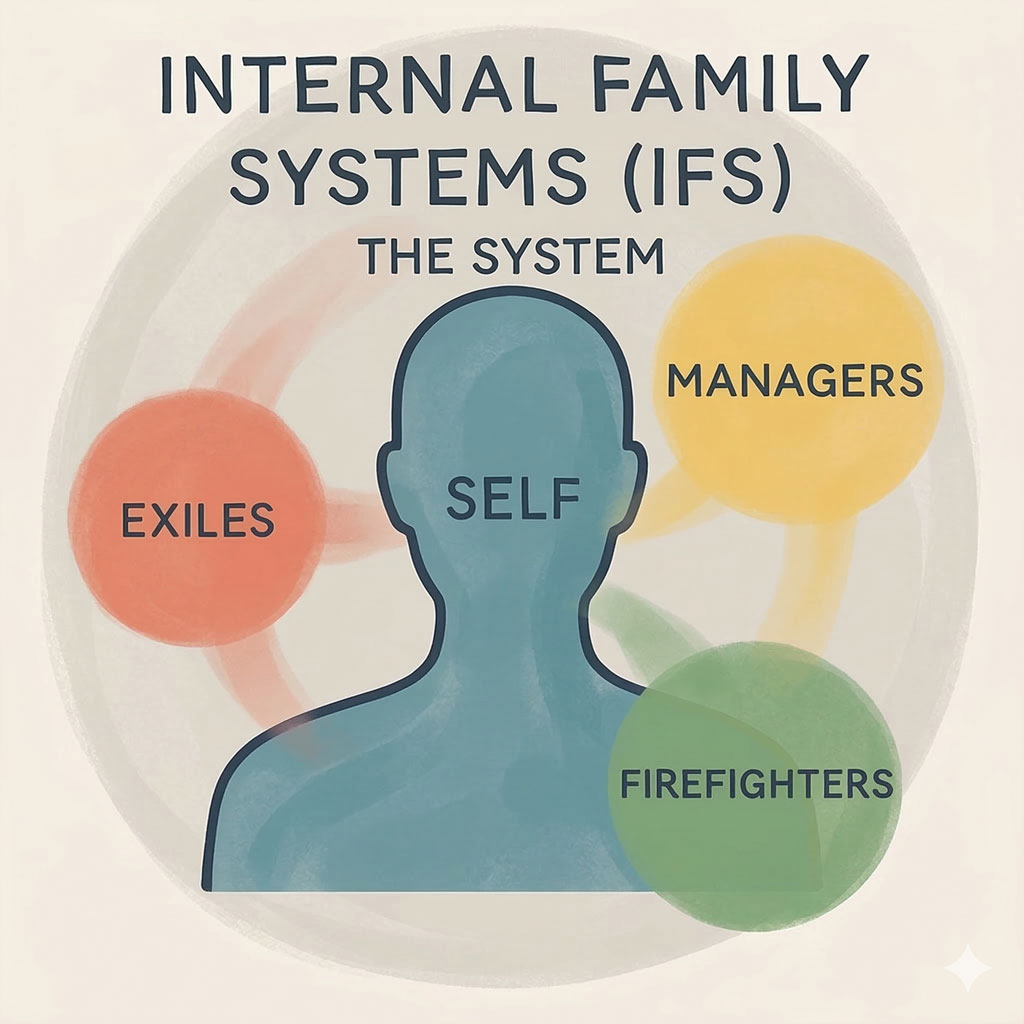
The Structure of the Internal Family: Managers, Firefighters, Exiles, and the Self
Our system consists of three categories of parts. The first two categories (Managers and Firefighters) serve a protective role, while the third category, which the model calls "Exiles," consists of the vulnerable, wounded parts of the self that are protected by the other two. The existence of "exiled" parts within a system is precisely what gives rise to the protective dynamics and determines the roles and behaviors of the parts that undertake this protection.
Managers
ManagersThey manage our daily lives and our outward image, functioning proactively to prevent the resurfacing of painful emotions.
Firefighters
FirefightersThey take action when the first line of defense fails. They function reactively, with the sole goal of immediately eliminating the emotional threat.
Exiles
ExilesThe vulnerable, wounded parts that carry our deepest wounds and are protected by the other two categories of parts (Managers & Firefighters).
Protective Parts: Managers and Firefighters
Although both types of parts perform a protective role, they use very different strategies to fulfil this role.
Managers
The First Line of Defense
Managers are the parts that handle our daily lives and our outward image. In short, they are the ones who "manage" the personality and attempt to control the internal and external world. They are parts that strive for perfection, use logic and analysis to help us explain/argue/interpret, criticize us so we become better or behave in socially acceptable ways, bring professional success through self-denial, ambition, and excessive effort, take on caretaking roles for others, aim to please others by limiting "no's" and boundaries, think pessimistically and always prepare for the worst-case scenario, or sugarcoat difficulties to avoid distress, etc.
Through their role, Managers essentially function proactively. Their goal is to create conditions so that painful emotions and situations experienced in the past (e.g., rejection, abandonment, isolation, loneliness, unworthiness, loss of control, etc.) never again repeat themselves or resurface in consciousness. Managers are parts of the self that work very hard, often becoming exhausted by the effort, and may ultimately fail. Consequently, the painful emotions carried by the wounded/vulnerable parts often flood the system and trigger the second category of parts (the "Firefighters"). Because these strategies are usually learned from a very young age, they possess an inherent "immaturity," making it difficult or sometimes impossible to cope with life challenges that constantly trigger the very emotions these parts desperately try to prevent. The "collapse" or malfunction/exhaustion of this protective system is one of the reasons that bring an individual to therapy (e.g., panic attacks, "depression").
Furthermore, with regards to reaching out for psychotherapy, it is common that a manager part makes the decision to "bring" a person to therapy (while other parts may resist or disagree). For example, a part that functions very logically, strictly, and needs control may push for "improvement" and psychotherapy when the individual "suddenly" has panic attacks at work, fearing exposure, shame, and a threat to their reputation or job. It is also common for such a part to "perform" the therapy itself (e.g., a logical/analytical part learning to "upgrade" its role through new perspectives), while other parts do not participate or benefit because they do not surface to express themselves. Regarding therapists, it is also common for us to conduct therapy through such parts (e.g., "smart/well-read" parts that need to find and provide answers, parts that need control, or parts that have taken on caretaking roles since childhood).
It is worth noting that the function of Managers can be very useful in our daily lives and that these parts don't necessarily create problems. Problems begin when these parts are expressed excessively, when they become "extreme," when they limit the expression of other parts, and when they are in polarization with parts that have different needs and strategies for the system's "well-being." Additionally, there are Managers who are not burdened by the protection of a vulnerable part (e.g., creative, happy, playful, wise parts). These parts enrich our lives, giving meaning and joy.
Finally, as IFS is a model well-suited for trauma therapy due to its embrace (and celebration) of multiplicity, the discussion of Managers is very close to the term "Apparently Normal Part of the personality" (ANP) used in the theory of Structural Dissociation (Van der Hart et.al., 2006) and utilized by prominent figures like Janina Fisher (Fisher, 2017). A significant difference between IFS and Structural Dissociation is that IFS does not pathologize the individual and avoids pathological terminology like the concept of "dissociation." This is also consistent with the Dialogical Self Theory developed by Hermans in the 1990s, which shares several commonalities with IFS.

- Perfectionism & ambition
- Logic & analysis
- Self-criticism
- Caretaking
- People Pleasing
- Pessimism
- Minimising/ Sugar-coating
Firefighters
The Reactive Line of Defense
- Addictions / Substance use
- Disconnection/ Dissociation
- Workaholism
- Impulsive behaviours
- Rage
Firefighters are the parts that take action when the first line of defence, the Managers, fails and painful emotions begin to leak to the surface, creating a sense of danger. Unlike Managers who function proactively, these parts function reactively (as "extinguishers") and do not particularly care about the "outward image"; their sole goal is the immediate elimination of the emotional threat. Firefighters adopt a short-term logic and do not "think" about long-term consequences. This means they are more impulsive, less "socially acceptable," and express themselves in ways that may "expose" us, leading to later regret. These are parts related to addictions (alcohol, drugs, smoking, food, sex, internet, gambling, work, shopping, etc.), parts that bring sudden disconnection (e.g., immersion in TV, phone, sleep), parts that get angry, enraged, or attack, and parts that bring dissociative symptoms (loss of memory, concentration, brain fog, depersonalization, etc.), self-harm, etc.
Example: The Internal Conflict
"…you must sit down and perfect the presentation and stop messing around on your phone, you'll get fired! You're useless!…"
Firefighters are often in polarization/conflict with Managers, even though they may serve the same purpose using different strategies. For instance, an ambitious and over-responsible part (Manager) might criticize a Firefighter part and vice versa: e.g., "...you must sit down and perfect the presentation and stop messing around on your phone, you'll get fired! You're useless!..." and on the other hand: "...I can't take this pressure anymore, I don't want to work all the time, I want to rest! I don't care about anything, let me miss the deadline..." In this case, the "responsible" part may be protecting against feelings of rejection by pushing for maximum effort, while the "impulsive" part "distracted by the phone" may also fear rejection and prefer to withdraw entirely from the effort so as to avoid experiencing rejection.
Regarding the search for psychotherapy, very often a Manager will seek therapy for a Firefighter's behavior (e.g., "I'm here because I can't stand behavior X anymore and I can't control it...") or, more frequently, the external system (parents, partners, work, school, or legal authorities) will push or pressure an individual into therapy or coaching because of the behavior of a firefigther. These conditions often create a negatively charged atmosphere where the client (and often the therapist) feels that this part is unwelcome and needs immediate change. This is understandable, as such parts can become very frightening (e.g., suicidal parts, substance-using parts, parts that restrict food, parts with murderous intentions). Working through the lens of IFS, the first and foremost goal for these parts is the acceptance and understanding of their role and intention (not necessarily the behavior and impact) before any discussion of behavioral change is made. If the behavior threatens safety, then careful management and exploration of protective measures (e.g., grounding, medication, hospitalization) are undertaken in collaboration with the client's parts that agree and see the benefit of this protection.
Vulnerable Parts of the Self: Exiles
Bearers of Our Deepest Wounds
These are the parts that have been traumatized, wounded, frightened, or shamed in the past and carry painful emotions, beliefs, memories, and sensations from those experiences. Because these experiences "threaten" internal cohesion, external relationship harmony, and daily functionality, our system "hides" and "exiles" these parts to protect them and to protect the system from being overwhelmed by what they carry. These are usually very young parts, though parts can be exiled at older ages too depending on experiences. Some of the most common "burdens" they carry are: guilt, shame, loneliness, fear, anger, helplessness, grief, emptiness, and worthlessness.
Exiles differ from protective parts in that they do not perform a specific protective role; they are the ones burdened with carrying our deepest wounds. While our protectors live by the motto "never be hurt again," our Exiles struggle to be heard and not forgotten in exile. They are aspects of us that can also become extreme in a desperate attempt to have their story heard. When these parts surface—due to the fragility of the protective system or its collapse during difficult experiences (e.g., a breakup, a job loss, a death, a new trauma)—the individual may be overtaken by sadness, fear, terror, vulnerability, or shame, significantly disrupting their daily life. At this point, many people seek therapy or medication.
A central goal of IFS therapy—like many models focusing on past-present connections and trauma—is to seek out, retrieve, and get to know these parts and their stories, creating a coherent narrative and integrating it into the individual's overall story, while offering healing to these parts and the system as a whole. Regarding the latter, releasing the burdens (unburdening) that each exiled part carries is focal in IFS. For this purpose, the model has a specially designed protocol / ritual that is particularly moving and liberating, distinct from the "methods" used in other psychotherapies.
IFS differs from many psychotherapy models in that it does not only see traumatic experiences and memories as isolated "incidents" to be integrated into a coherent narrative or made conscious, but rather it sees entire parts of the self or "sub-personalities" that carry memories, emotions, beliefs, and behavioral patterns, just as a "whole" person would. A part of ourselves is much more than a "voice" or a memory. According to Anderson (2020), our parts live in the mind but utilize neural circuits in the brain for their expression.
Another difference with other therapeutic modalities is that IFS devotes significant time to the protective system built around vulnerable parts, honoring them and seeking "permission" to access the Exiles. The concept of "resistance" in IFS takes a very different form compared to psychodynamic approaches. Instead of a "problem" to be "solved," resistance is the ultimate expression of protection and "love" toward the self from parts that have sacrificed themselves for the system. We never bypass the protective system; instead, we get to know it, understand it, and ask for its permission and cooperation to move toward the most vulnerable areas of the system. As we heal the vulnerable parts, the protective system becomes more flexible, as it no longer needs to function rigidly, gradually restoring balance and harmony. Furthermore, as our Exiles are "healed" and release their burdens, space opens up to welcome new positive qualities or old childhood traits that were "forgotten" or buried under trauma, such as creativity, play, joy, enthusiasm, and spontaneity.

Exile Burdens
- Guilt
- Shame
- Loneliness
- Fear
- Anger
- Helplessness
- Grief
- Emptiness
- Worthlessness
The Self as the System's Healer
Self-Leadership · Being Parts-Led vs Self-Led · 8 Cs

According to the model, there is also a field/energy within us, a "Me" that is not a part, but is our center—a core Self/Energy that the model distinguishes from other uses of the term "self" by using a capital S: the Self. This Self exists within all of us; it is a healthy, healing force, present from birth and indestructible regardless of traumatic life conditions (though trauma may deprive us of access to the Self and its qualities). This Self has leadership abilities and is ideally intended to be the "leader" of the system. For this reason, the model frequently refers to the terms "Self-Leadership" or being "Self-Led" (a system led by the Self) in contrast to being "Parts-Led" (a system led by parts). According to the model, the Self has the following qualities, known as the 8 Cs:
Curiosity
Compassion
Confidence
Creativity
Clarity
Calm
Connectedness
Courage
The central goal of the model is to have a "Self-Led" system. This does not mean that parts do not participate, but that they are under the "leadership," "guidance," "oversight," and "compassionate gaze" of the Self. The process of psychotherapy seeks to activate this Self and access its qualities. When an individual has enough Self-energy, they can work therapeutically with their parts and help them release the burdens they have carried with such self-sacrifice. Consequently, the model is not just a psychotherapy model but a "way of life." Many clients dialogue with their parts outside of sessions, can perform significant therapeutic work on their own, and can become figures of regulation for the parts of others and carriers of Self-energy for society. The model is not limited to the therapeutic hour; it is not exclusive to the therapist; it belongs to everyone and spreads to all aspects of life.
“"And so, the time has come for me to speak. My very existence overflowed with gratitude, love, and understanding. How much has this system done for me? What battles has it fought? How much has it carried? How much love has it given? Yet, I wasn't always there. I wasn't listening; I didn't know; I didn't care. How little I knew about these so very important ones [referring to the parts].Back then, the system would strike out with pain and throw punches into the dark. It was their desperate attempt to be heard, to make their presence felt, to finally speak. For a long time, I couldn't hear the words or the thoughts behind the thoughts—until the day the system hurt me so deeply, and the 'Giant' [a protector] threw me into the profoundest darkness [depression] with a single blow. They all knew that this was the only way I would truly listen. The only way I would travel to the darkest corner of the abyss and lay the firmest foundations.They want me to reach the sky; they want me to touch the sun without being burned. I was born again through that darkness. Like the mythical crimson bird, I fly now, and nothing frightens me. The entire system is now held beneath the wings of my love. They know I am there for them, bound by a sacred and indestructible bond, and I will never leave them.They trust me even more than they trust their own inner depths, and in return, I offer the greatest love of all. The most sacred. The truest. Know Thyself. I am there to heal every wound and to provide a soothing balm to our pain…"